




Neurosciences
Area coordinators:
- Enrique Baca García
EBaca@quironsalud.es
Consult CV -
José María Serratosa Fernández
JMSerratosa@fjd.es
Consult CV
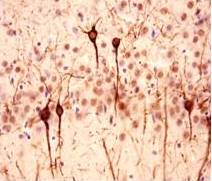
The research activities of the Neurosciences Area are focused on the genetic and clinical study of a wide range of diseases and disorders affecting the Central Nervous System (CNS), including epilepsies (including rare diseases in which epilepsy is one of the main manifestations), dementias, movement disorders, mental disorders and suicidal behaviour. Additional research lines include pharmacogenetics in psychiatry, psychiatric care, and motion analysis in neurological and psychiatric disorders.
The Neurology group focuses on the study of highly prevalent CNS disorders, such as epilepsies, dementias and movement disorders, as well as rare neurological diseases including Lafora disease, developmental and epileptic encephalopathies, familial dementias and Huntington’s disease. These studies make use of molecular genetics techniques and animal models, with the goal of translating research findings into clinical practice through the implementation of novel therapeutic strategies aimed at curing these disorders.
The Psychiatry and Mental Health group investigates the genetic and environmental factors involved in the onset, progression and treatment of mental disorders. To define clinical phenotypes, the group applies ecological momentary assessment (EMA) technologies and machine learning approaches. This objective is complemented by research into factors affecting the delivery of care within public mental health services. Emphasis is placed on schizophrenia, affective disorders and substance use disorders, as these represent some of the most severe and prevalent mental health conditions. An additional area of focus is suicidal behaviour, which remains one of the leading causes of mortality in Western countries.
The Mitochondrial Calcium Signalling and Ageing Group investigates the role of Ca²⁺ signalling in brain metabolism and studies the involvement of Aralar and SCaMC proteins in human disease.
.
Specific objectives for 2025 include:
- To develop a gene therapy for Lafora disease. Lafora Epilepsy Cure Initiative (LECI).
- To study the natural history of Lafora disease and translate research findings into clinical practice through controlled clinical trials.
- To establish registries of rare genetic epilepsies to create cohorts of patients with specific mutations who may be eligible for future clinical trials aimed at developing personalised treatments.
- To continue identifying phenotypes associated with genetic epilepsies to improve the clinical care of affected patients.
- To develop devices capable of detecting epileptic seizures and monitoring seizure frequency in patients’ homes.
- To investigate clinical-genetic correlations and biomarkers in familial dementias and cognitively preserved nonagenarians
- To identify Parkinson’s disease subtypes with distinct clinical and phenotypic progression patterns. This includes the study of several aspects of Parkinson’s disease, such as the effects of safinamide, hypomimia, remission of parkinsonian tremor, and motor assessment using external monitoring devices.
- To investigate the factors affecting the delivery of care to patients with mental disorders within public healthcare services, particularly in schizophrenia, affective disorders, substance use disorders and suicidal behaviour.
- To study the role of Ca²⁺ signalling in brain metabolism and the contribution of Aralar and SCaMC proteins to human disease.
Neurosciences Area Scientific Activity
|
2025 |
Neurology |
Psychiatry and Mental Health |
Mitochondrial calcium signalling |
TOTAL |
|
|
PROJECTS |
→EU/NIH PROJECTS |
1 |
// |
// |
1 |
|
→ISCIII PROJECTSI |
// |
3 |
// |
3 |
|
|
→CIBER PROJECTS |
// |
// |
// |
// |
|
|
→MINISTRY-FUNDED PROJECTS |
// |
// |
// |
// |
|
|
→CAM PROJECTS |
1 |
2 |
// |
3 |
|
|
→AWARDS |
1 |
// |
// |
1 |
|
|
→ NON-OFFICIAL PROJECTS |
15 |
7 |
// |
22 |
|
|
→OBSERVATIONAL STUDIES |
7 |
10 |
// |
17 |
|
|
TOTAL |
25 |
22 |
// |
47 |
|
|
CLINICAL TRIALS |
→ EARLY-PHASE TRIALS (I, I/II, II) |
4 |
// |
// |
4 |
|
→ LATE-PHASE TRIALS (II/III, III, III/IV O IV/OTHERS) |
17 |
8 |
// |
25 |
|
|
TOTAL |
21 |
8 |
// |
29 |
Neurosciences Area Publications
|
2025 |
Total number of publications |
No of publications with an Impact Factor |
Cumulative impact factor |
Average annual impact factor |
No of publications in Q1 journals |
% of publications in Q1 journals |
Nº of Open Access Publications |
No of Clinical Practice Guidelines |
|
Neurology |
44 |
44 |
183.4 |
4.17 |
22 |
50.00% |
29 |
1 |
|
Psychiatry and Mental Health |
23 |
23 |
76,5 |
3,33 |
9 |
39.13% |
17 |
1 |
|
Mitochondrial Calcium Signalling |
1 |
1 |
3,9 |
3,90 |
1 |
100.00% |
1 |
0 |
|
NEUROSCIENCES AREA |
68 |
68 |
263.8 |
3.88 |
32 |
47.06% |
47 |
2 |
List of the five most relevant publications in the Neurosciences Area in 2025
Impact of Digital Safety Plan Activation on Subsequent Emergency Departments Visits Following an Initial Suicide Attempt: Quasi-Experimental Study.
Barrigón ML, Schmidt C, Elices M, Porras-Segovia A, De Granda-Beltrán AM, Artés-Rodríguez A, Courtet P, Pérez-Sola V, Baca-García E.
JMIR Ment Health. 2025 Jun 17.12:e70253.
PMID: 40526825
IF: 5,8
http://dx.doi.org/10.2196/70253
Advancing Risk Assessment in Myotonic Muscular Dystrophy Through Translational Research and Personalized Medicine.
Amarante-Cuadrado C, Vazirani R.
JACC Clin Electrophysiol. 2025 May.11(5):1039.
PMID: 40436470
IF 7,7
http://dx.doi.org/10.1016/j.jacep.2025.02.045
Prevalence, disability, and economic impact of migraine in Spain: a nationwide population-based study.
Sanchez-Del-Rio M, García-Azorín D, Peral C, Armada B, Irimia-Sieira P, Porta-Etessam J.
J Headache Pain. 2025 May 15.26(1):117.
PMID: 40375151
IF: 7,9
http://dx.doi.org/10.1186/s10194-025-02069-1
Artificial intelligence in healthcare: Revolution or unfulfilled promise?
Anmella G, Baca-García E.
Eur Neuropsychopharmacol. 2025 Feb 15.94:1-3.
PMID: 39956012
IF: 6,7
http://dx.doi.org/10.1016/j.euroneuro.2025.01.006
Decoding the general role of tRNA queuosine modification in eukaryotes.
Díaz-Rullo J, González-Moreno L, Del Arco A, González-Pastor JE.
Sci Rep. 2025 Jan 02.15(1):345.
PMID: 39747999
IF: 3,9
http://dx.doi.org/10.1038/s41598-024-83451-y
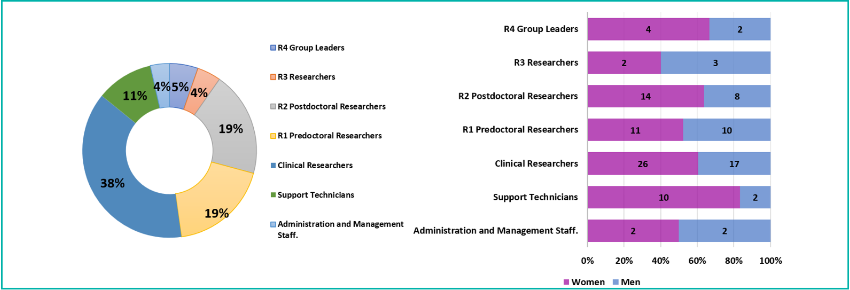
Gender Perspective in the Neurosciences Area
The Neurosciences Area is composed of a team of professionals committed to respect, diversity and equality among its members. The area seeks to promote the professional development of all staff, ensuring equal opportunities and preventing discrimination on the grounds of gender or age.
Future Challenges for the Neurosciences Area
- Development, validation and implementation of systems for monitoring motor activity in neurological and psychiatric disorders, enabling the assessment of disease severity.
- Development of diagnostic and therapeutic tools to improve the care of patients affected by brain disorders.
- Identification of genes involved in neurological and psychiatric diseases and their interactions with environmental factors, with the aim of achieving more accurate and personalised genetic diagnoses and more effective treatments.
- Establishment of an animal models unit for neurological diseases to support the development and preclinical testing of therapies prior to their evaluation in humans.
- Development of advanced therapies for brain disorders, including gene therapy, antisense oligonucleotides, antibody-drug/enzyme conjugates, and drug repurposing strategies.
- Investigation of the role of Ca²⁺ signalling in brain metabolism and the generation of tissue-specific ARALAR knockout mouse models to precisely determine its role and evaluate the potential use of ketogenic diets for the treatment of epileptic seizures.
- Neuropharmacology and therapeutic approaches for Parkinson’s disease and movement disorders, including deep brain stimulation and novel pharmacological treatments.
- Consolidation of machine learning applications for the analysis of genetic and healthcare databases in Psychiatry.
- Development and validation of diagnostic tools based on next-generation sequencing technologies for the study of both common and rare forms of epilepsy.
- Establishment of reference units dedicated to the study of rare forms of dementia, movement disorders and epilepsy.
- Accurate diagnosis of genetic dementias.
- Neurogenetics of movement disorders, particularly dystonia, ataxia and Parkinson’s disease.
- Investigation of the factors influencing the care provided to patients with mental disorders within public healthcare services, particularly those affected by schizophrenia, affective disorders and suicidal behaviour.
- Development of technologies for the identification and assessment of digital phenotypes
Research Groups
- Neurology
- Psychiatry and Mental Health
- Mitochondrial Calcium Signalling