




Genomics and Epidemiology
Data update as of 31/12/2025
Area Coordinator:
- Carmen Ayuso García
CAyuso@fjd.es
Consult CV
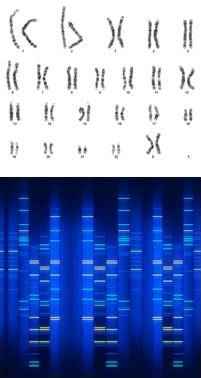
The Genomics and Epidemiology Area conduct its scientific activities through a range of research projects focused on rare and common genetic diseases. These projects address their pathophysiological, cellular and molecular characterisation, the development and validation of diagnostic techniques and algorithms, and epidemiological analyses in patient cohorts. The goal is to design clinically useful tools with clear applications in patient care, while facilitating the development of new therapeutic strategies.
Its objectives include both area-specific goals and cross-cutting objectives aimed at providing methodological support and specialised expertise to the other research groups and areas of IIS-FJD:
Objectives of the area:
- Understanding the molecular basis of rare and complex diseases
- Development of algorithms for the analysis and interpretation of omics data through the application of Bioinformatics and Systems Biology.
- Translation of biotechnology into postnatal diagnosis and the prevention of genetic disorders through prenatal and reproductive diagnosis in different clinical fields, including ophthalmology, paediatrics, neurology, hereditary cancer, cardiology, nephrology and others.
- Development of therapeutic approaches based on pharmacogenetics (PGx), cell and gene therapies, and molecular targets
- New experimental approaches and innovation. Single-cell and mosaicism studies; long-read whole-genome sequencing (WGS) and optical genome mapping. Validation of diagnostic kits for repeat expansion disorders and new developments in NIPT and PGT-M/PGT-A
- Preventive Medicine, Public Health and Primary Care Group: development of epidemiological studies, both independently and in collaboration with other groups, on chronic and communicable diseases; assessment of the impact of vaccination on communicable diseases; implementation of training and dissemination activities; and promotion of Good Research Practice principles through educational and outreach initiatives
CROSS-CUTTING OBJECTIVES:
- To apply a genomic approach to the study of common diseases, opening new research lines in neurological, psychiatric, oncological and cardiovascular disorders.
- To identify genetic determinants and pharmacogenetic (PGx) factors that contribute to the progression of rare and complex diseases, enabling the selection of more individualised therapies and advancing genomic and personalised medicine..
- To analyse and implement organisational, ethical and regulatory aspects related to Genomics, Big Data and Artificial Intelligence.
Scientific Activity of the Genomics and Epidemiology area
|
2025 |
Genetics and Genomics of Rare and Complex Diseases |
Preventive Medicine, Public Health and Primary Care Associated Group |
TOTAL |
||||
|
PROJECTS |
→ EU/NIH PROJECTS |
// |
// |
// |
|||
|
→ ISCIII PROJECTS |
11 |
1 |
12 |
||||
|
→ CIBER PROJECTS |
1 |
// |
1 |
||||
|
→ MINISTRY-FUNDED PROJECTS |
5 |
// |
5 |
||||
|
→CAM PROJECTS |
2 |
// |
2 |
||||
|
→AWARDSS |
// |
1 |
1 |
||||
|
→NON-OFFICIAL PROJECTS |
5 |
3 |
8 |
||||
|
→OBSERVATIONAL STUDIES |
// |
1 |
1 |
||||
|
TOTAL |
24 |
6 |
30 |
||||
|
CLINICAL TRIALS |
→ EARLY-PHASE TRIALS (I, I/II, II) |
// |
// |
// |
|||
|
→ LATE-PHASE TRIALS (II/III, III, III/IV O IV/OTHERS)) |
// |
3 |
3 |
||||
|
TOTAL |
// |
3 |
3 |
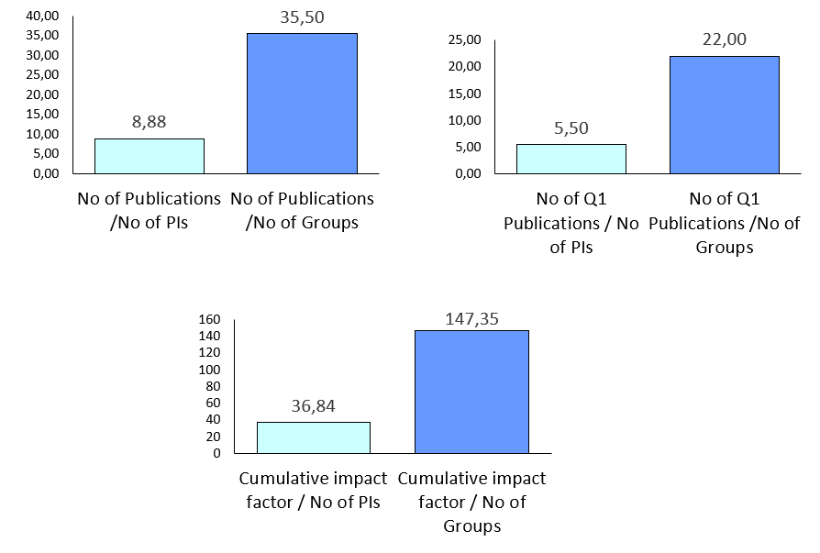
Genetics and Genomics Area Publications
|
2025 |
Total number of publications |
No of publications with an Impact Factor |
Cumulative impact factor |
Average annual impact factor |
No of publications in Q1 journals |
% of publications in Q1 journals |
Nº of Open Access Publications |
No of Clinical Practice Guidelines |
|
Genetics and Genomics of Rare and Complex Diseases |
28 |
27 |
133 |
4.93 |
19 |
70.37% |
24 |
1 |
|
Preventive Medicine, Public Health and Primary Care Associated Group |
43 |
43 |
161.7 |
3.76 |
25 |
58.14% |
26 |
6 |
|
GENOMICS AND EPIDEMIOLOGY RESEARCH AREA |
71 |
70 |
294.7 |
4.21 |
44 |
62.86% |
50 |
7 |
 List of the five most relevant publications of the Genetics and Genomics Area during 2025
CCL18: a potential immunosuppressive biomarker for prognosis in ABC diffuse large B-cell lymphoma.
Rodríguez M, Rojas-Vega F, Díaz-Alejo JF, Mahillo-Fernández I, Serrano C, López A, Morales-Ruiz T, Roldan-Arjona T, Sánchez-García J, Río-Machín A, Morillo D, Pérez MA, Córdoba R, Llamas-Sillero P, Rodríguez-Pinilla SM, Serrano-López J.
Front Immunol. 2025.16:1693730.
PMID: 41472741
IF: 5,9
http://dx.doi.org/10.3389/fimmu.2025.1693730
Dual Action of Dipyridamole in Experimental Rheumatoid Arthritis: Suppression of Joint Inflammation and Upregulation of Muscle Anabolism via Adenosine and AMPK pathways.
Marco-Bonilla M, Fresnadillo M, Sanchez-Platero I, de la Riva-Bueno M, Huete-Toral F, Carracedo G, Conde C, Benitez Y, Minguez P, Cifuentes SC, Rams J, Herrero-Beaumont G, Largo R, Mediero A.
Arthritis Rheumatol. 2025 Dec 29.
PMID: 41466573
IF: 10,9
http://dx.doi.org/10.1002/art.70047
SARS-CoV-2 mutant spectrum complexity is an epidemiologically evolvable trait.
Martínez-González B, Soria ME, de Ávila AI, Somovilla P, Aguilar-Sabido C, Mínguez P, Ferrer-Orta C, Salar-Vidal L, Lorenzo-Redondo R, Delgado S, Morán F, Verdaguer N, Gadea I, Domingo E, Perales C.
Proc Natl Acad Sci U S A. 2025 Sep 30.122(39):e2515706122.
PMID: 40991435
IF: 9,1
http://dx.doi.org/10.1073/pnas.2515706122
Long-Read Whole-Genome Sequencing as a Tool for Variant Detection in Inherited Retinal Dystrophies.
Rodilla C, Núñez-Moreno G, Benitez Y, Rodríguez de Alba M, Blanco-Kelly F, López-Alcojor A, Fernández-Caballero L, Perea-Romero I, Del Pozo-Valero M, García-García G, Balanzá M, Villaverde C, Zurita O, Jubin C, Fund C, Delepine M, Leduc A, Deleuze JF, Millán JM, Minguez P, Corton M, Ayuso C.
Int J Mol Sci. 2025 Apr 18.26(8).
PMID: 40332496
IF: 4,9
http://dx.doi.org/10.3390/ijms26083825
Bi-allelic variants in three genes encoding distinct subunits of the vesicular AP-5 complex cause hereditary macular dystrophy.
Kaminska K, Cancellieri F, Quinodoz M, Moye AR, Bauwens M, Lin S, Janeschitz-Kriegl L, Hayman T, Barberán-Martínez P, Schlaeger R, Van den Broeck F, Ávila Fernández A, Fernández-Caballero L, Perea-Romero I, García-García G, Salom D, Mazzola P, Zuleger T, Poths K, Haack TB, Jacob J, Vermeer S, Terbeek F, Feltgen N, Moulin AP, Koutroumanou L, Papadakis G, Browning AC, Madhusudhan S, Gränse L, Banin E, Sousa AB, Coutinho Santos L, Kuehlewein L, De Angeli P, Leroy BP, Mahroo OA, Sedgwick F, Eden J, Pfau M, Andréasson S, Scholl HPN, Ayuso C, Millán JM, Sharon D, Tsilimbaris MK, Vaclavik V, Tran HV, Ben-Yosef T, De Baere E, Webster AR, Arno G, Sergouniotis PI, Kohl S, Santos C, Rivolta C.
Am J Hum Genet. 2025 Apr 03.112(4):808-828.
PMID: 40081374
IF: 8,1
http://dx.doi.org/10.1016/j.ajhg.2025.02.015
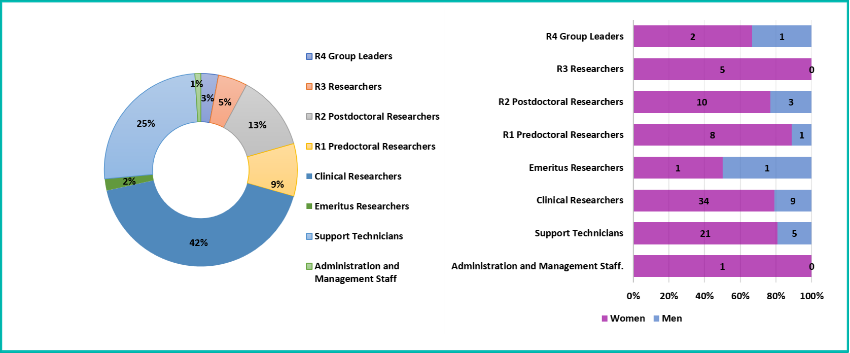
Gender Perspective in the Genetics and Epidemiology Area
The Genomics and Epidemiology Area is composed of a team of professionals committed to respect, diversity and equality among its members. The Area seeks to promote the professional development of all staff, ensuring equal opportunities and preventing discrimination on the grounds of gender or age.
Future challenges for the Genomics and Epidemiology Area
- Epidemiology and molecular basis of rare and complex diseases: identification of new genes, loci and variants involved in human diseases with a genomic basis. Hidden genetic causes of cancer, cardiovascular disease and neurodegeneration; inherited retinal dystrophies; intellectual disability and neurodevelopmental disorders; and ocular malformations.
- Integration of basic (functional genomics and proteomics) and translational research: development, validation and harmonisation of diagnostic techniques and identification of novel therapeutic target.
- Research into therapies applicable to genetic diseases: pharmacogenetics (PGx), pharmacological therapies and advanced therapies, including gene therapy, gene editing (CRISPR/Cas9) and cell reprogramming using induced pluripotent stem cells (iPSCs), encompassing cell culture, cell line characterisation and genetic monitoring.
- Translation: to clinical practice through the development of diagnostic algorithms, the application of artificial intelligence tools, and the implementation of protocols and clinical guidelines for rare and complex diseases:
- New experimental approaches and innovation, including single-cell and mosaicism studies; long-read whole-genome sequencing (WGS) and optical genome mapping; genome-wide methylation studies using arrays and long-read sequencing; transcriptomic analyses using RNA-seq; multi-omics integration; validation of diagnostic kits for repeat expansion disorders; and new developments in non-invasive prenatal testing (NIPT) and preimplantation genetic testing for monogenic disorders and aneuploidies (PGT-M/PGT-A).
- Development and validation of bioinformatics tools and algorithms for the reanalysis of undiagnosed cases, the processing of data generated by emerging technologies, and their translation into clinical practice.
- Validation of NGS procedures and cross-cutting processes in clinical genetic diagnosis, including informed consent, report formats, panel and algorithm design, implementation of whole-exome sequencing (WES), and ORPHA coding.
- Assessment of the scientific and societal impact of our research activities.
- Harmonisation of regulatory and ethical aspects related to the use of genomics and health data within the Institute and at national and international levels.
- Consolidation of participation in epidemiological studies, both observational and interventional, on communicable diseases such as respiratory syncytial virus (RSV), COVID-19 and others.
- Promotion of related educational activities, including the Immunisation Workshop, the Scientific Integrity Workshop, and the Research Workshop for secondary school and high school students.
- Consolidation of national and international collaborations.
Research Groups
- Genetics and Genomics of Rare and Complex Diseases Group
- Preventive Medicine, Publich Health and Primary Care Associated Group