




Healthcare Technology and Innovation
Data update as of 31/12/2025
Area coordinators:
- Damián García Olmo
damian.garcia@quironsalud.es
Consulta su CV
Following approval by the IIS-FJD Research Committee and External Scientific Advisory Committee, the research areas were restructured. As a result, in 2025 the Preventive Medicine, Public Health and Primary Care Group became part of the Genetics and Genomics Area, which was subsequently renamed the Genomics and Epidemiology Area.
This cross-cutting strategic area is composed of five consolidated research groups and two associated groups, primarily focused on the application of novel healthcare technologies for diagnosis and the implementation of innovative therapeutic approaches.
Its objectives include:
- Innovation in Ophtalmology Group: To establish the utility of adipose tissue-derived mesenchymal stem cells in an in vitro model of conjunctivochalasis and Meibomian gland dysfunction. To validate a patented algorithm for intraocular lens power calculation in patients with irregular corneas. To participate in Phase II and Phase III clinical trials evaluating investigational drugs for inherited retinal diseases, macular degeneration and uveitis. To collaborate with the Spanish National Research Council.
- Medical Engineering Research and Development Group: We will continue to advance the European EIC Pathfinder project "MOSAIC" (GAP-101186537). Significant progress has been made in the design of an optoacoustic sensor that enables non-invasive blood pressure measurement, and the first pilot clinical trial is scheduled to be conducted. In parallel, we are carrying out a comprehensive clinical evaluation of a new dermatological imaging device in the field of aesthetic dermatology. We also continue our research lines in optometry and ophthalmology, with new developments focused on paediatric screening, the detection and grading of keratoconus, and the incorporation of adaptive optics into our refractive error measurement systems.
- New Therapies Research Group: Study of the ADSC secretome in wound healing and submission of a clinical trial application to the Spanish Agency of Medicines and Medical Devices (AEMPS). Investigation of methylated SEPTIN9 (mSEPTIN9) in rectal cancer. Development of a clinical trial on cell therapy for urinary incontinence. Development of a system for the treatment of intraluminal tumours. Preclinical toxicity studies of peritoneal collagenase and submission of a clinical trial application to the AEMPS. Specifically, the Otorhinolaryngology team will conduct the following studies:
- -A randomised, double-blind, placebo-controlled study to evaluate the efficacy and safety of dupilumab in patients with uncontrolled chronic rhinosinusitis without nasal polyps (CRSsNP).
- -A Phase III, randomised, double-blind, parallel-group study to evaluate the efficacy and safety of 100 mg subcutaneous depemokimab in patients with chronic rhinosinusitis with nasal polyps (CRSwNP) (GSK).
- - A Phase IV, randomised, double-blind, head-to-head study comparing dupilumab versus omalizumab in patients with severe chronic rhinosinusitis with nasal polyps (CRSwNP) and concomitant asthma.
- - An international, Phase III, randomised, double-blind, placebo-controlled trial to evaluate the efficacy and safety of tezepelumab in patients with severe chronic rhinosinusitis with nasal polyps (CRSwNP) (AstraZeneca).
Medical and Surgical Innovation Group: PEvaluation of the effects of metoprolol in patients with community-acquired pneumonia. Development of tools based on the analysis of physiological monitoring signals to support the management of critically ill patients. Multicentre study of the use of continuous haemodynamic monitoring worldwide. Evaluation of the impact of the duration and depth of hypotension in patients with septic shock.
Advanced Therapies Group: The group plans to apply to the Spanish Agency of Medicines and Medical Devices (AEMPS) for authorisation of a gene therapy clinical trial for patients with Diamond-Blackfan anaemia. An additional clinical trial will be submitted for the treatment of graft-versus-host disease using genetically modified mesenchymal stromal cells. The group will also continue the development of transposon-generated CAR-T cells for the treatment of lymphomas and will initiate work aimed at extending the use of these CAR-T cells to the treatment of patients with lupus, in a programme coordinated by Fundación Jiménez Díaz. In parallel, preclinical studies on gene therapy and gene editing for the treatment of haematopoietic disorders will continue. In collaboration with Rocket Pharma, the group will maintain the follow-up of three pivotal gene therapy clinical trials, and marketing authorisation applications will be submitted for two of these therapies.
Regenerative Medicine and Tissue Bioengineering Group: In vivo gene correction using viral vector-mediated gene editing for Recessive Dystrophic Epidermolysis Bullosa and Pachyonychia Congenita. Clinical trial: Mesenchymal Stromal Cells (MSCs) for the treatment of chronic wounds (EudraCT 2019-004637-16). Correction of disease-causing mutations in Epidermolysis Bullosa through base editing and prime editing technologies. MSC-based cell therapy for Epidermolysis Bullosa. Development of aptamer-based therapies for chronic wound healing, inflammation, fibrosis and hair follicle disorders. Preclinical studies of MSC-based cell therapy in an animal model of Epidermolysis Bullosa. Characterisation of new fibrosis modulators and therapeutic approaches for Recessive Dystrophic Epidermolysis Bullosa. Development of a microfluidic system for Skin-on-a-Chip applications. Clinical development of a gene-editing Advanced Therapy Medicinal Product (ATMP) for Epidermolysis Bullosa
UAM NursingAssociatedGroup:Extracorporeal Circulation and Perfusion: The group is committed to providing students with comprehensive training and equipping them with the competencies required for advanced clinical practice and research in extracorporeal circulation and perfusion across all areas of application. Through this advanced training, the group aims to improve the quality of care and patient safety for individuals requiring these specialised techniques
Scientific Activity of the Healthcare Technology and Innovation Area
|
2025 |
Innovation in Ophtalmology |
Medical Engineering Development and Innovation |
Research in New Therapies |
Advanced Therapies |
Regenerative Medicine and Tissue Bioengineering |
Medical and Surgical Innovation |
Nursing UAM: Extracorporeal Circulation and Perfusion |
TOTAL |
|
|
PROJECTS |
→ EU/NIH PROJECTS |
// |
// |
1 |
// |
// |
// |
// |
1 |
|
→ ISCIII PROJECTS |
2 |
// |
7 |
5 |
2 |
1 |
// |
17 |
|
|
→ CIBER PROJECTS |
// |
// |
// |
1 |
1 |
// |
// |
2 |
|
|
→ MINISTRY-FUNDED PROJECTS |
// |
// |
// |
// |
// |
// |
// |
// |
|
|
→CAM PROJECTS |
// |
// |
// |
1 |
// |
// |
// |
1 |
|
|
→AWARDS |
// |
// |
// |
// |
// |
// |
// |
// |
|
|
→NON-OFFICIAL PROJECTS |
4 |
// |
16 |
12 |
3 |
10 |
1 |
46 |
|
|
→OBSERVATIONAL STUDIES |
1 |
// |
3 |
// |
// |
5 |
// |
9 |
|
|
TOTAL |
7 |
// |
27 |
19 |
6 |
16 |
1 |
76 |
|
|
CLINICAL TRIALS |
→ EARLY-PHASE TRIALS (I, I/II, II) |
4 |
// |
5 |
// |
// |
3 |
// |
12 |
|
→ LATE-PHASE TRIALS (II/III, III, III/IV O IV/OTHERS) |
5 |
// |
11 |
// |
// |
9 |
// |
25 |
|
|
TOTAL |
9 |
// |
16 |
// |
// |
12 |
// |
37 |
|
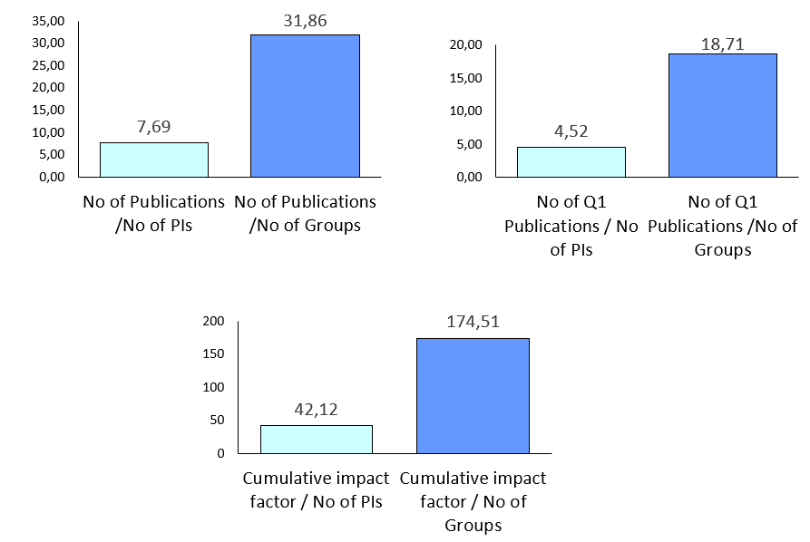
Health Technology and Innovation Area Publications
|
2025 |
Total number of publications |
No of publications with an Impact Factor |
Cumulative impact factor |
Average annual impact factor |
No of publications in Q1 journals |
% of publications in Q1 journals |
Nº of Open Access Publications |
No of Clinical Practice Guidelines |
|
Innovation in Ophthalmology |
29 |
26 |
9.,4 |
3.71 |
18 |
69.23% |
21 |
1 |
|
Medical Engineering Development and Innovation |
2 |
2 |
16 |
8.00 |
2 |
100.00% |
1 |
0 |
|
Medical Engineering Development and Innovation |
92 |
86 |
311.8 |
3.63 |
41 |
47.67% |
65 |
8 |
|
Medical Engineering Development and Innovation |
41 |
41 |
521.6 |
12.72 |
31 |
75.61% |
33 |
1 |
|
Medical Engineering Development and Innovation |
11 |
11 |
66.3 |
6.03 |
8 |
72.73% |
10 |
0 |
|
Medical Engineering Development and Innovation |
48 |
46 |
209.5 |
4.55 |
31 |
67.39% |
31 |
5 |
|
Medical Engineering Development and Innovation |
// |
// |
// |
// |
// |
// |
// |
// |
|
HEALTHCARE TECHNOLOGY AND INNOVATION AREA |
223 |
212 |
1221.6 |
5.76 |
131 |
61.79% |
161 |
15 |
List of the five most relevant publications of the Health Technology and Innovation Area during 2025
Base edited skin equivalents with clinical potential for ex vivo correction of recessive dystrophic epidermolysis bullosa.
Bassons-Bascuñana A, Duarte B, Méndez-Jiménez E, Ugalde L, Sanabria-Betrián P, Aussel C, Peña-Gutiérrez I, Olalla-Sastre B, Ammann S, Cathomen T, Del Rio M, Río P, Larcher F, López-Manzaneda S.
Mol Ther. 2025 Nov 17.
PMID: 41254941
IF: 12
http://dx.doi.org/10.1016/j.ymthe.2025.11.023
Lentiviral Gene Therapy for Severe Leukocyte Adhesion Deficiency Type 1.
Booth C, Sevilla J, Almarza E, Kuo CY, Zubicaray J, Terrazas D, O'Toole G, Chitty-Lopez M, Choi G, Nicoletti E, Long-Boyle J, Fernandes A, Chetty K, De Oliveira S, Banuelos C, Xu-Bayford J, Bastone AL, John-Neek P, Jackson C, Moore TB, Gilmour K, Schambach A, Rothe M, Kasbekar S, Rao GR, Patel K, Shah G, Thrasher AJ, Bueren JA, Schwartz JD, Kohn DB.
N Engl J Med. 2025 May 01.392(17):1698-1709.
PMID: 40305711
IF: 78,5
http://dx.doi.org/10.1056/NEJMoa2407376
Depigmentation of RPE Hypertrophy in Vogt-Koyanagi-Harada Syndrome.
González-Coín EJ, Carreño E.
JAMA Ophthalmol. 2025 Mar 01.143(3):e246230.
PMID: 40111315
IF: 9,2
http://dx.doi.org/10.1001/jamaophthalmol.2024.6230
Implementing a closed loop clinical decision support system for sustainable preoperative care.
Gracia Martínez JL, Pfang B, Morales Coca MÁ, Caramés Sánchez C, Del Olmo Rodríguez M, Villegas García MA, Short Apellaniz J, Arcos Campillo J, Álvaro de la Parra JA, Manzano Lorefice F, Muñoz Alameda LE.
NPJ Digit Med. 2025 Jan 03.8(1):6.
PMID: 39753745
IF: 15,1
http://dx.doi.org/10.1038/s41746-024-01371-7
All-in-one gene therapy alternative for DBAS.
Navarro S, Río P.
Cell Stem Cell. 2025 Jan 02.32(1):4-6.
PMID: 39753111
IF: 20,4
Gender Perspective in the Health Technology and Innovation Area
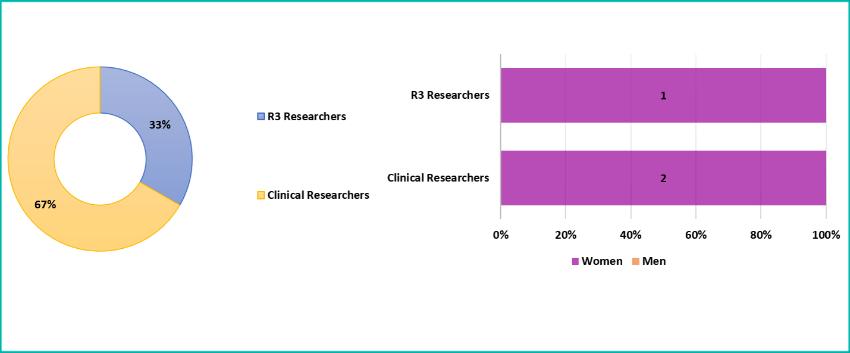
The Health Technology and Innovation Area is composed of a team of professionals committed to respect, diversity and equality among its members. The Area seeks to promote the professional development of all staff, ensuring equal opportunities and preventing discrimination on the grounds of gender or age.
Future challenges the Healthcare Technology and Innovation Area
- To develop cloud-based tools for the personalised calculation of intraocular lens power based on corneal tomography.
- To design a new multicentre study on the use of stem cells for the treatment of autoimmune diseases of the conjunctiva.
- To analyse the outcomes of our corneal cross-linking protocol according to patient age.
- To assess the utility of high definition aberrometry in predicting quality of life in patients with endothelial dystrophy.
- To participate in the national prospective registry of patients with endophthalmitis.
- To develop a porcine model of perianal fistula and evaluate treatment with frozen and lyophilised ADSC secretome.
- To submit documentation on ADSC-derived exosomes to the Spanish Agency of Medicines and Medical Devices (AEMPS) for the development of a clinical trial in complex perianal fistula.
- To validate methylated SEPTIN9 (mSEPTIN9) as a biomarker in gastrointestinal tumours.
- To conduct a clinical trial using ADSCs for the treatment of wound dehiscence through modulation of the microbiome.
- To perform preclinical studies to validate a GMP-manufactured collagenase and submit a clinical trial application for its use as an adjuvant to HIPE.
- To conduct a clinical trial evaluating butyrate for the treatment of diverticulitis.
- To develop CAR-NK therapies targeting gastrointestinal tumours in the preclinical setting.
- To apply to the AEMPS for a gene therapy clinical trial in patients with Diamond-Blackfan anaemia.
- To apply to the AEMPS for a clinical trial using genetically modified mesenchymal stromal cells for the treatment of graft-versus-host disease.
- To continue the follow-up of patients enrolled in the Phase I/II pivotal gene therapy clinical trial for Fanconi anaemia type A.
- In collaboration with Rocket Pharma, to seek marketing authorisation for gene therapy for Leukocyte Adhesion Deficiency Type I.
- To initiate a Hospital Exemption programme for the gene therapy treatment of Fanconi anaemia type A.
- To consolidate the use of the porcine model for training in cervical surgical techniques and the development of head and neck surgical skill.
- To implement a cadaveric model for training in sialendoscopy technique.
- To improve the surgical skills of ENT residents in head and neck surgery using live-animal (porcine) surgical simulation models.
- To develop new aptamer-based therapies for impaired wound healing, inflammation and alopecia.
- To evaluate the effects of metoprolol in patients with ARDS and investigate the long-term cardiovascular consequences of ARDS.
- To develop tools based on physiological monitoring signal analysis to support the management of critically ill patients.
- To advance the regulatory and clinical phases of an ex vivo gene-editing clinical trial for Epidermolysis Bullosa.
- To develop gene-editing therapies for rare inherited skin disorders with both recessive and dominant inheritance patterns.
- To investigate mechanisms of fibrosis and cancer and develop novel therapeutic approaches for Epidermolysis Bullosa.
- To consolidate participation in epidemiological studies, both observational and interventional, on communicable diseases such as RSV and COVID-19.
- To promote related educational activities, including Immunisation Workshops, the Scientific Integrity Workshop, and the Research Workshop for secondary school students.
- To consolidate national and international collaborations